Lessons in Audio Book Narration

by Abbe Holmes

If you’ve ever thought that audio book narration is for you.

Or you’re an author whose publisher wants you to narrate your own book, then you’ll probably want to know more about the whole process.

The big news is that the growth of audio books and, with it, the search for excellent narrators is growing.

If you have a love of words and language, understand plot and structure and the definitions of a first, second or third person narration…

and you have a really interesting, engaging voice and are a solid sight reader…

…then there’s no reason why you couldn’t make a splash in this area.

Skills for Successful Audio Book Narration.

You may be thinking, “Well sure.  I love reading and I can read well, so I’d be good at this”.

And that may well be true.

But there are a few other things that are true about audio books.

The first thing I want to say is that audio book narration is a deeply specialised craft.

Skills you’ll need are far more than reading words in ‘your’ voice.  

You need to interpret the narrator or lead character’s voice, the authors intention and the overall tone of the work.

This could mean taking on a particular persona or attitude.  It could mean creating a ‘character’ voice.  And it could mean having to voice several different characters, differing sometimes vastly in in age and gender.

Audio Book Narration Checklist

Here’s a checklist of skills that may help you to identify what you already have or what you may need to get better at. You:

  • are a lover of words and language
  • read books and have a wide and varied interest
  • listen to audio books and know what works and why
  • understand the differences between 1st, 2nd or 3rd person narration
  • have a voice that’s clear and resilient enough to read for long periods of time and remain consistent in performance style and energy
  • have the ability to understand the difference between delivering narration to the listening audience and creating believable scenes and characters with dialogue.

If you already do these things, or understand these concepts, then you may have, by default, given yourself some initial essential skills for audio book narration.


What’s Involved in Audio Book Narration

Read the rest of the article at VoiceoverCoach.com.au…

Voice Actor’s Guide in Choosing a Microphone

by Erica Rosales

Your microphone is the linchpin of all your equipment – your best friend in your lifelong career as a voice actor. Despite the magic an audio editing software can do, the quality of your microphone plays the biggest role in determining the overall quality of your voice over recordings. For this ultimate reason, it’s truly a daunting task for voice actors to choose a microphone.

But in the brand spectrum of every product, we always know what’s topnotch. So what actually makes it hard for us to settle for a purchase when we already knew what’s superb? It’s hard to decide because let’s admit it, we’re all down to the monetary concerns. Practically, you would first dig deep into the popular and latest claims on the best microphones at a very affordable price.

The good news is, contrary to popular belief, the cost is not perfectly parallel to the microphone’s quality. The microphone is actually not one-size-fits-all equipment. It’s relative to your voice, your studio, and the supporting tools alongside.

The Voice Realm presents this definitive guide in choosing a microphone that spans across different microphone types, connectivity, mic character, quality, and budget. Let’s take a look at what’s well worth the investment for you.

Three Types of Microphones

USB Microphone

This kind of mic is what we highly recommend if you are really on a tight budget and are after portability. There are USB mics that are also condenser mics. USB mic plugs directly to your computer’s USB port without any additional equipment, making it very convenient if you do most of your projects at your home studio or if you’re always on the go with your laptop. This mic type captures an above-average sound which is not bad for entry-level voiceover project. However, USB microphones are not as versatile as the regular microphones because they are dependent on your computer. Therefore, USB mics are not for you if you do more of your work in the field or stages.

Read the rest of the article at The Voice Realm…

Are You Pimping Your Voice?

by Paul Strikwerda

I apologize in advance for what you’re about to read. I’m a bit fired up today.

What’s going on?

Well, I made the mistake of once again visiting the Voice Acting Alliance (Unofficial Group) Facebook Group. That’s the 9,300 member strong group where pretend voice actors will do pretty much anything for nothing.

If you’re serious about voice acting and you’re looking for solid advice, do yourself a favor and find another online community. Please.

You’ll avoid encountering people tackling pressing issues such as:

“Who will critique my s****y demo recorded in the closet with $70 worth of equipment. Kindly ignore the neighbor’s rottweiler.”

“I been having a hard time finding acting classes so if anyone could give me some references or pointers. I be very grateful.”

“I haven’t done any voice acting in this group yet. If any of you need a voice just let me know. I’m currently learning myself.”

I thought I’d give a test with the Kaotica Eyeball in case anyone would like to give this ball a try. Enjoy.”

I just learned what “slating” means… 10 auditions later…”

and the ultimate question:

“What food do voice actor eat?” (seriously!)

If I may, I’d like to add the following query:

“What diaper do voice actor wear?”

SPOON FEEDERS UNITE

The most surprising thing is that some colleagues with too much time on their hands take these questions seriously, and they start helping the ignorant members of this group under the guise of “giving back to the community.”

Excuse me, but that’s not giving back. This is spoon feeding toddlers and teens who are too lazy to do their homework. If you want to stand any chance as a future voice actor, you have to be self-sufficient instead of becoming dependent on people you don’t even know.

Read the rest of the article at Nethervoice…

Achieving Work-Life Balance in the Voice Over Industry

by Erica Rosales

Freelance jobs like voice over often promise the advantage of having a flexible work environments that makes you achieve a balance between your profession and private life. This is why many full-time freelance voice actors claim that being able to work from their home studios works the best for them. This is true to a great extent — as you no longer need to slip out of your yoga pants or pajamas to start recording that 3000-word audiobook voice over. 

However, it’s not always easy to balance life and career even if you are the boss of your own career. In fact, having a job that gives you a complete freedom can sometimes be detrimental to your time. Sure, it gives you a sense of power and control for being able to do your job wherever and whenever you want to. You tend to be consumed by a delusion that you are on top of your tasks both work-related and personal. By being able to multitask, you tend to maximize the flexibility of your schedule and create a thinking that you have a work-life balance because of the power to do personal things even during work hours. 

Little did you know, mixing up your non-work stuff with your workspace actually lead to more work hours being consumed. Then sooner or later, you’ll just perhaps feel like your life is already revolving around your job. So what actually is work-life balance and how do we do it in voice over?

What Is Work-Life Balance?

The work-life balance definition sets out to achieve an ideal balance between a person’s working life and private life. It is a concept in which the maximum happiness of an employee acts as the fuel for productive and fulfilling work, for which both employer and employee are responsible.

How to strike the correct work-life balance in voice over?

Today, work-life balance ranks as one of the most important workplace attributes — second to compensation.

Achieving a healthy work-life balance requires managing our professional and personal life in sustainable ways that keep our energy flowing, our minds and bodies healthy and our whole selves happy and content.

It means giving due attention to all of the things that enrich and fulfill us including work and career, health and fitness, family and relationships, spirituality, community service, hobbies and passions, intellectual stimulation, rest and recreation.

Here are the steps that can help you keep the balance between your life and your career.

Track Your Time

Analyzing your present situation is the beginning step in achieving a balanced life. Keep a time log of everything you do for one week, including work-related and personal activities. This data will serve as an eye-opener, helping you understand how you are using — and where you are losing — your time.

Determine Your Priorities

Read the rest of the article at The Voice Realm…

2P or Not 2P: That is the Question

by Joshua Alexander

CONTROVERSY!  FIRE AND BRIMSTONE!  TAR & FEATHER HIM!

Disclaimer: I already know this is going to be a long and most certainly controversial blog for those who have been involved in the voiceover industry.  Breathe easy.  I’ll say some things you’ll like; I’ll say something that will make you want to throw a microphone at me.  (Please throw 416’s or Neumanns only, as I can turn around and sell them to pay for my hospital stay.  Thanks!)  Either way, please know that I am not endorsing any one approach; I’m simply talking about what has worked for me as a voiceover businessman.  I’m fully cognizant that I’m putting myself out there on the chopping block, and going out on a limb.  So be it.  Here goes…

THE REST WAS HISTORY

Voiceovers.  It’s not what it used to be.  Is it worse, or is it better?

As J. Michael Collins stated in a recent webinar with Jon Florian on VoiceoverXtra, lower rates and fighting harder for good pay is “the new normal.”  The question here is what will you and I do to adapt and overcome?  The market has changed.

Many years ago, when puppies were the oldest animals, you’d get a call from your agent, hop in the car, drive to a recording studio, record in front of producers and technicians and end clients (maybe), and then return home and pray and wait.  Then, when you’re awarded the job, you hop in the car, drive to a recording studio, record in front of producers and technicians and end clients (maybe), and then return home and pray and wait…for a paycheck.

Now, with the advent of the Internet, home studios are springing up all over the globe, in closets and custom builds alike.  They can run anywhere from a clothes closet to a pipe-and-drape setup to a WhisperRoom or StudioBricks studio.  And they truly allow flexibility in recording and auditioning.

It used to be a situation where you could cock your eyebrow, give your head a little George-Clooney-shake swagger, and say “Call my agent.”  Now, the question looms on the horizon, especially in the state of Washington as it pertains to the National Right-to-Work foundation, are agents even necessary?  As VO Agent Alliance states:

According to the National Right-To-Work Legal Defense Foundation (nrtw.org), “a Right-to-Work law secures the right of employees to decide for themselves whether or not to join or financially support a union.” Each state has its own statutes regarding this issue and should be researched online or at your library or through contacting SAG-AFTRA directly. Right-to-Work states include states include: Alabama, Arizona, Arkansas, Florida, Georgia, Idaho, Iowa, Kansas, Louisiana, Mississippi, Nebraska, Nevada, North Carolina, North Dakota, Oklahoma, South Carolina, South Dakota, Tennessee, Texas, Utah, Virginia, and Wyoming. The remaining states are considered “closed shops.” Nearly half the country falls under Right-to-Work, which more or less renders the unions, in our case SAG-AFTRA, somewhat useless.

So where does that leave us, represented and non-represented alike?

TIME TO BEAT THE STREETS

What does all of this mean for the hardworking agent-dependent voiceover artist?  Ultimately, it means that they need to look for more work on their own.

Voiceover agents used to be the gateway to voiceover work.  “You want voiceover work?  Gotta get an agent.”  Not so anymore.

Read the rest of the article at SeattleVoiceActor.com…

Taking Your Show On The Road

by 

I just recently went to my first podcasting convention (MAPCON, now the Independent Podcast Conference in Atlantic City) and had the privilege of meeting a lot of super talented and passionate people who create and have services for, podcasters (of which, I am now one!).  One of the topics that came up time and time again, was sound treatment.  How do you get the best sound for your podcast?  How do you get rid of echo, cut down on ambient noise, and travel with your sound equipment while still putting out a decent show?

A lot of people will tell you that it’s all about the microphone.  And it’s true that if you use a microphone that’s highly directional and of decent quality, you can get pretty good sound.

BUT – without the right recording environment, your audio still isn’t going to sound very good – no matter how expensive your microphone is.

I’m here to tell you – it’s all about the sound treatment.

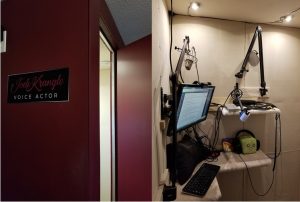
As a voice actor, I have a 5×4 sound treated booth that has thick, insulated walls and a similar ceiling and floor, all carpeted so there are no sharp edges or surfaces for sound to echo off of. (I’ve included a picture below of both the inside and outside of my booth.) It makes for an almost entirely dead sound that engineers prefer, because then they can go in and color that sound in post, the way they need it.  You probably don’t need this elaborate a set-up as a podcaster, but you get the idea.

Read the rest of the article at VoiceoversAndVocals.com…

Source-Connect is the Standard and I’m a Standard Bearer

by Peter K. O’Connell

There are nice things about being in a club.

I’m not talking about the leather-chair, cigar smoking clubs out there (I’ve been members at those kind of clubs…they are not that big a deal).

I’m mean like clubs where members share a common interest and can talk about things you each know about and, as a member, you can learn from people who share your interests…like audio production and voiceover. Turns out there’s a kind of club for that.

Technology brought a lot of change to the industry, some of it bad (pay to play voiceover web sites) and some of it good.

One of the good things was Source-Connect, which uses codecs and the internet to offer recording studios, media producers, voiceover talents like me and other audio professionals high-quality options to record and monitor recording sessions remotely.

Source-Connect is (has been) replacing ISDN, which was the industry standard for remote recording.

Read the rest of the article at Voxmarketising…

Voice Actor’s Secret to Getting Repeat Clients

by Erica Rosales

Who would want to settle on one-time voice over projects and squeeze their source of income solely out of jobs taken by chance and with no promise of repeat? It’s sure as hell every voice actor’s business goal — to establish a strong customer relationship and make recurring clients.

1. Earn your client’s trust and confidence

Bear this in mind: Your aim is to not just earn a quick buck. Your ultimate goal is to cultivate a long-term connection with your clients.

Just because you have the best testimonials and big reputation, doesn’t mean you need not to exert effort in focusing on your clients. They do not care about what others say and they won’t be convinced unless they experience your merit first-hand. Therefore, you must earn their confidence and trust that they are in good hands. Reassuring your client from time to time when needed and continuously proving yourself is part of your job to make them feel secure.

2. Exceed your client’s expectation with the voice over value you provide

Perhaps every voice actor is capable of delivering a good output. The battle here is who outstands and exceeds the industry standard. You have to deliver a stellar voice over product that is more than the price paid. You’re not just in the business of providing a mediocre voice over. You are in the business of adding value. If the client sees you thriving to provide more value than what is asked, they will surely get impressed and value you too.

3. Submit your voice over output the earliest you can

Make it a habit to not just meet a deadline, beat it! Everyone loves having something finished ahead of time. So if you submit your voice over product to your client early, there’s nothing you can cause them but happiness and satisfaction which convert to repeating business with you.

4. Reply your clients as fast as you can

Read the rest of the article at The Voice Realm…