
Email Marketing

by Carrie Olsen

Voice actors reach out to me all the time and ask, “How do I book more voice over work?”. It actually makes sense if you think about it. After you get started, learn all you can skill-wise, the next logical step is to wonder how to get a job doing voice over work. If you look around my blog you’ll find all kinds of resources on things that you need to be prepared for voice-over work.

I tackle everything–from areas you need to build up so you can have a solid voice over foundation, a successful business, and make a living doing voiceover work to technical how-tos on how to get a good demo made,  best practices for auditioning, and programs on booking e-learning narration work.

How to Book Voiceover Work: Do Email Marketing

I want to spotlight one specific method for making contacts and turning them into paid voice over work: email marketing.

What is email marketing?

As it pertains to a voiceover business, email marketing is doing focused, targeted, personal outreach to clients or potential clients who are likely to hire you for voiceover work.

These clients aren’t necessarily going to hire you immediately, and that’s okay because that’s not the goalThe goal is to build relationships.

Let’s get this out of the way: This is a long-term process. The idea isn’t to send out 50 emails, book 50 jobs, and be instantly successful. The idea is to use a long-term strategy to build solid relationships so that when these prospects need voiceover help down the line, you already have an “in”. You’re already top-of-mind. They already feel comfortable with you and a partnership comes naturally.

How do you do email outreach so that you can build strong, natural relationships with people who have the potential to hire you? Let’s break it down.

Steps in Doing Email Outreach to Build Strong Relationships

1. Identify your target market.
  • The first thing is you need to know is who it is that you’re targeting. if you check out my Book More E-learning course, you can learn all about how to target e-learning clients. But if you’re interested in commercial work or explainer videos or other corporate narration type jobs, your outreach is going to look different.

Read the rest of the article at CarrieOlsenVO.com…

The Voiceover Negotiator (Establishing & Defending Your Voiceover Rates)

by Peter K. O’Connell

Some voice talent come into the voiceover business with blinders on…all they see are microphones, scripts and money. The business part they kind of “poo-poo” away dismissively, only to find themselves later to be playing catch up or out of the business entirely.

There are lots of books and videos and classes and seminars on all this voiceover business stuff.  Today, I thought I’d share my perspective on how to establish rates and execute negotiations after almost 40 years in voiceover. This isn’t all inclusive (you have to PAY for that 😉 ) but I will share some of what I feel are key points.

The business part of voiceover starts almost immediately, when you get your first job. Say it’s a commercial for a local bank…a local bank that has multiple branches across your state. It’s going to be on the radio and it’s :60 seconds. The client who offers you the job is a video production studio doing the production and hiring of the VO talent.

The studio offers you $50 for the gig.

Boy are you excited, first paying gig, heard across the state! All my family will hear it! This is my big break…here we go!

The excitement is understandable and natural.

SFX: Splashing a bucket of cold water on the new voice talent

Slow down there, Secretariat! Don’t jump into the studio yet.

That $50 fee is WAY too low for a regional radio spot.

If you accept the spot for that rate, you’ve established yourself as a VO who works way below rates and trust me, the studio KNOWS the REAL going rates for voiceover.

Read the rest of the article at Voxmarketising…

CA’s AB-5: A Legal Expert (and Voice Actor) Responds

by Dave Courvoisier

This is the part of interactive journaism I love.  Blogging isn’t exactly journalism, unless you happen to be a life-long journalist; then I think it qualifies.

And to qualify, a journalist has to be willing to go the extra length to make sure he gets the story right in the end.  I think with today’s addition to the question about AB-5, the facts are coming clear.

Peter Marx, a long-time member of the LA legal community, and now a voice actor too, wrote me in response to last week’s blog about AB-5.  He was glad I brought the issue to the fore, but had the courtesy to school me a little on the facts.

Thanks, Peter!

Read below to see his unedited response to me.

CourVO 

Dave,

I’ve been reading your blog for the last year or so, and appreciate that you share your views. I write to suggest, respectfully, that certain aspects of your post on January 2 about California AB 5 may be a bit misleading, or at least result in unnecessary concern. I have always found the VO community to be supportive and helpful, and what follows is offered in that spirit.

By way of background, I am an LA based voice actor, and though I’ve been around for awhile, as a practical matter I’m relatively new to the field. I have also been a member of the California Bar for over 50 years, and while now pretty much retired, one area of focus in my practice was employment law. I still serve as a mediator, and over the years have mediated countless cases where the primary issue was misclassification, i.e., did management misclassify a worker as an independent contractor rather than as an employee.

In 2018 the California Supreme Court decided Dynamex Operations West, Inc. v. Superior Court, which substantially affected the ability of employers to classify workers as independent contractors. (Pursuant to the court’s opinion, Dynamex appears to have a business model similar if not identical to Uber, the main difference being that Dynamex transports packages rather than people.) The Dynamex opinion is somewhat limited in its application, but in adopting AB 5 the legislature stated its intent to “codify … Dynamex and … clarify the decision’s application in state law.”

Read the rest of the article at CourVO.com…

Are You In Voice-Over Career Level One, Two Or Three? Advice For Where You Are NOW …

by Dan Hurst

I’m pretty fed up with the voice-over business.
No, not doing voice-overs. I love that! And I adore my VO clients!
But some periphery businesses that attach themselves to this industry have gone Bell Curve batsh** crazy.
The vast majority of businesses in this industry are high class, dependable, necessary companies that operate with integrity and in the best interests of voice talents and their clients.
However, there are a few on the ends of the Bell Curve that are a drag and an embarrassment to the honor and wholeness of this business that the vast majority of us love so much.
I suppose I could say the same about voice talents.
We’re all discovering who they are, and who they are not. This business has gotten large enough that it’s time we begin to understand its immensity and how we all fit in – or if we do.
CATEGORIZING VO CAREER LEVELS
The nearest business we can compare ourselves to is stage and screen acting. We are, after all, voice actors. In fact, many of us crossover into both disciplines. And the businesses that serve us are similar to the businesses that serve the physical actors.
With that in mind, it’s time we begin to understand how the immensity of our community breaks down. It does actually break down pretty much the way the theatre and screen actors industry separates.
I see our industry of voice talents as being divided into three groups. While there are exceptions to every category, I think this helps explain the state of our business.
AMATEUR / HOBBIEST
First (and foremost), there is the amateur or hobbiest level. It is where we all started.
I can remember in my early radio days when I was expected to voice a spot at no charge for a radio client. I did it because it was my job. And I remember the thrill of a client telling me that the spot I voiced was getting great results.
That was enough for me. At the time.
By far (I’m guessing here. I don’t have the numbers, but it makes sense), the largest group of voice talents is the spectrum of talents who are doing this for free or minimal charge.

2P or Not 2P: That is the Question

by Joshua Alexander

CONTROVERSY!  FIRE AND BRIMSTONE!  TAR & FEATHER HIM!

Disclaimer: I already know this is going to be a long and most certainly controversial blog for those who have been involved in the voiceover industry.  Breathe easy.  I’ll say some things you’ll like; I’ll say something that will make you want to throw a microphone at me.  (Please throw 416’s or Neumanns only, as I can turn around and sell them to pay for my hospital stay.  Thanks!)  Either way, please know that I am not endorsing any one approach; I’m simply talking about what has worked for me as a voiceover businessman.  I’m fully cognizant that I’m putting myself out there on the chopping block, and going out on a limb.  So be it.  Here goes…

THE REST WAS HISTORY

Voiceovers.  It’s not what it used to be.  Is it worse, or is it better?

As J. Michael Collins stated in a recent webinar with Jon Florian on VoiceoverXtra, lower rates and fighting harder for good pay is “the new normal.”  The question here is what will you and I do to adapt and overcome?  The market has changed.

Many years ago, when puppies were the oldest animals, you’d get a call from your agent, hop in the car, drive to a recording studio, record in front of producers and technicians and end clients (maybe), and then return home and pray and wait.  Then, when you’re awarded the job, you hop in the car, drive to a recording studio, record in front of producers and technicians and end clients (maybe), and then return home and pray and wait…for a paycheck.

Now, with the advent of the Internet, home studios are springing up all over the globe, in closets and custom builds alike.  They can run anywhere from a clothes closet to a pipe-and-drape setup to a WhisperRoom or StudioBricks studio.  And they truly allow flexibility in recording and auditioning.

It used to be a situation where you could cock your eyebrow, give your head a little George-Clooney-shake swagger, and say “Call my agent.”  Now, the question looms on the horizon, especially in the state of Washington as it pertains to the National Right-to-Work foundation, are agents even necessary?  As VO Agent Alliance states:

According to the National Right-To-Work Legal Defense Foundation (nrtw.org), “a Right-to-Work law secures the right of employees to decide for themselves whether or not to join or financially support a union.” Each state has its own statutes regarding this issue and should be researched online or at your library or through contacting SAG-AFTRA directly. Right-to-Work states include states include: Alabama, Arizona, Arkansas, Florida, Georgia, Idaho, Iowa, Kansas, Louisiana, Mississippi, Nebraska, Nevada, North Carolina, North Dakota, Oklahoma, South Carolina, South Dakota, Tennessee, Texas, Utah, Virginia, and Wyoming. The remaining states are considered “closed shops.” Nearly half the country falls under Right-to-Work, which more or less renders the unions, in our case SAG-AFTRA, somewhat useless.

So where does that leave us, represented and non-represented alike?

TIME TO BEAT THE STREETS

What does all of this mean for the hardworking agent-dependent voiceover artist?  Ultimately, it means that they need to look for more work on their own.

Voiceover agents used to be the gateway to voiceover work.  “You want voiceover work?  Gotta get an agent.”  Not so anymore.

Read the rest of the article at SeattleVoiceActor.com…

Voice Actor’s Secret to Getting Repeat Clients

by Erica Rosales

Who would want to settle on one-time voice over projects and squeeze their source of income solely out of jobs taken by chance and with no promise of repeat? It’s sure as hell every voice actor’s business goal — to establish a strong customer relationship and make recurring clients.

1. Earn your client’s trust and confidence

Bear this in mind: Your aim is to not just earn a quick buck. Your ultimate goal is to cultivate a long-term connection with your clients.

Just because you have the best testimonials and big reputation, doesn’t mean you need not to exert effort in focusing on your clients. They do not care about what others say and they won’t be convinced unless they experience your merit first-hand. Therefore, you must earn their confidence and trust that they are in good hands. Reassuring your client from time to time when needed and continuously proving yourself is part of your job to make them feel secure.

2. Exceed your client’s expectation with the voice over value you provide

Perhaps every voice actor is capable of delivering a good output. The battle here is who outstands and exceeds the industry standard. You have to deliver a stellar voice over product that is more than the price paid. You’re not just in the business of providing a mediocre voice over. You are in the business of adding value. If the client sees you thriving to provide more value than what is asked, they will surely get impressed and value you too.

3. Submit your voice over output the earliest you can

Make it a habit to not just meet a deadline, beat it! Everyone loves having something finished ahead of time. So if you submit your voice over product to your client early, there’s nothing you can cause them but happiness and satisfaction which convert to repeating business with you.

4. Reply your clients as fast as you can

Read the rest of the article at The Voice Realm…

Voiceover Rates – The Biggest Threat To Our Industry

by Hugh Edwards

What is the future of voiceover rates? That’s a very big question. It is in fact, the biggest question of our time. This blog post tackles that very subject and also what Gravy For The Brain is doing about it. We have exciting news…..and have potentially solved many of the industry rates issues.

The GFTB Rate Guide V2 is now live, and comes with many new concepts and new features.

But before we look at the V2 voiceover rate guide, let’s look at what the actual problems of the industry are regarding voiceover rates.

1. What are the Problems with Voiceover Rates in the Industry?

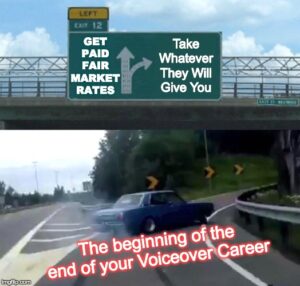
Over the last half decade we have seen global voiceover rates spiral downwards in what has become known as the ‘race to the bottom’. This has become a circular problem and in the main has been caused directly or indirectly by the advent of the Pay To Play (or subscription) sites, like Voices.com, Voice123, bodalgo, Mandy and so on.

(For a full list of all P2P sites, check out our very own V.O.I.D. – the Voiceover Internet Database which lists all voiceover companies, globally)

The main reasons that the P2P sites have caused this issue with voiceover rates and their degradation, are as follows:

  1. The P2P sites have not educated the hirers with regard to the average rates that are charged for average voice jobs within the industry, nor have they educated them on why the rates are traditionally averaged as they have been; it’s been left purely up to the hirers who use the sites to decide what they want to pay
  2. The P2P sites have actively encouraged the voiceover artists applying for the jobs to engage in a ‘bidding’ process. It’s a natural progression that VO’s are motivated to ‘bid lower’ voiceover rates to be able to get the work.
  3. As the industry has grown and expanded in recent years, the P2P sites have not educated the newer voice artists as to what normal/average voiceover rates are/were, and are presenting opportunities with much lower-than-normal pricing as good opportunities.
  4. Many P2P sites are heavily weighted in favour of the hirer because without jobs they cannot sustain their main income, which is the subscription fees paid by the voice artists; there is the weighted temptation to offer cheaper and cheaper rates to hirers in a hope to attract their custom.
  5. Some P2P sites are offering ‘end-to-end’ services to the hirers to cast and manage the process, so that the hirer doesn’t have to get involved, and therefore taking a much larger portion of the hirer’s budget in doing so than is paid to the voice artist doing the work-for-hire.

With that all said, we can’t blame the P2P sites for everything! While they are a key component in the reasons for degradation of current voiceover rates, there are other factors at play:

  1. The internet century is booming; there is an ever-increasing demand for content and part of that is voiceover. The vast majority of companies who did not traditionally use voiceover in their history simply do not know what ‘normal’ voiceover rates actually should be, and simply make guesses. We see here, again, a lack of education on voiceover rates.

Read the rest of the article at Gravy for the Brain…

Voiceovers And Incorporating

by Tom Dheere

I’ve been giving the whole voiceover-business-incorporating question some thought.

I see that question online almost every day and it’s become even more pressing for many voice talents ever since the new tax code passed. For a long time I have held that most voice talents are incorporating for two reasons:

  1. Because somebody who knows nothing about the voiceover industry tells them to
  2. It makes them feel professional and/or important

Clearly, neither of those are good reasons. I’m also sick & tired of seeing new voice talents asking the same questions over and over and over when all of the information is already out there. See my rant from a few weeks ago. With that in mind, here is an incorporating Q&A. A big thanks to Rob Sciglimpaglia and Hal Peterson who spoke at APAC 2018 for their new and insightful data. While I won’t relay all of the info they shared (it was a panel that people paid good money to attend), I will fold in some of their insights into what I already know.

Q: What is a corporation?

A: For the purposes of this conversation, a corporation is an entity designed to protect your personal assets in case bad things happen to your business.

Q: Why does a voice talent’s business need incorporating anyway?

A: Because sole proprietors have zero legal protection in case bad things happen.

Q: What kind of bad things?

Read the rest of the article at TomDheere.com…