The Totally Uncensored List of Casting Director Pet Peeves

by Marci Liroff

The Totally Uncensored Casting Director

By Marci Liroff

It’s that time of year again. During the summer break my casting director colleagues get together and celebrate the end of pilot season before episodic casting starts up again. Inevitably, we get to talking about our pet peeves in the audition room. Amid the cocktails, we regale each other with hilarious tales mixed with some scary ones.

In the interest of education, I’d like to share them with you so that you’re not “that guy” who’s making a bad name for himself in offices throughout the town.

Don’t wear perfume or cologne. Year after year this seems to be the #1 peeve from my colleagues. Please remember that we have to sit in an often small and cramped room without ventilation for hours on end. When you come in wearing your girlfriend/boyfriend’s favorite scent we have to live with it for the next several hours. Some of us are highly sensitive and allergic to perfume and get migraines and nausea. Think of the casting office like you would a doctor’s office. Don’t do it!

No weapons, not even fake ones. I’ve had actors pull fake guns and knives on me – it was very traumatic. If a scene asks you to pull a knife out of your jacket … please don’t do that in an audition. Especially if you don’t tell the CD before hand. This could lead to furniture being toppled and a big producer putting you in a choke hold.”

This one is very simple. Wear underpants.

This seems so basic I hesitate to even share it, but, make sure your picture and resume are stapled together before you arrive at the casting office. Don’t ask to borrow my stapler or my assistant’s stapler. Make sure your contact info and agent/mgr. is written on the photos and your resume in case they get separated – which happens all the time. When I ask you for your picture, don’t hand me three different choices and ask me to pick which one – make a choice beforehand.

Excuses. Leave them home. Actors that preface their audition with an excuse, “I was tired, sick – all it says to me is, “get ready, I am going to be really bad today.”

Coming in with a bad attitude. Never underestimate the effect being pleasant has on everyone.

Don’t prop yourself up with props. Don’t use a prop in a scene unless you are totally comfortable with it. I’ve seen props totally befuddle some people. A phone is fine. Just don’t set up a one-person show – unless you’re Carrot Top.

If it’s a driving scene, you don’t have to pretend to actually “drive” the car.

For The Men: I’m not going to have sex with you so don’t even TRY to seduce me into thinking you are a better actor than you are. Charm is good. Wit. Personality. But flirting in a creepy way is…well.. creepy.

Be nice and courteous to everyone. You never know: that receptionist could end-up being a director or producer some day. And the interns definitely “rat-you-out” when you leave. The guy who used to clean my toilets was nominated for an Oscar ten years later.


Read the rest of the article at MarciLiroff.com…

5 Tips for Heading Back to Acting School After a Break

by Ajarae Coleman

Article Image

Photo Source: Photo by Anthony from Pexels

Even if you’ve been out of traditional school for a while, there is something magical about this back to school time of year. The laid-back vibes of summer vacation are at an end, our days are getting shorter and cooler (in the northern hemisphere anyway), and we feel a little more motivated to buckle down and get to work.

If you’re an actor who has taken some time off from your training, you may be itching to get back to it. So, how do you decide where to go? Acting classes are a huge investment of time, money, and creative energy, and you deserve the best training for where you are in your career right now. Here are five steps you can take to decide what training is a good fit for you.

1. Determine your current career goals.
There are countless categories of acting training available—scene study, script analysis, improvisation, stage combat, audition technique, on-camera classes—these are just a few! When you’re researching the landscape of options, it’s easy to feel overwhelmed. So it’s imperative that you spend some time getting clear on your desired next step in this phase of your career. If your goal is to land a co-star on a television sitcom, then comedy and improv training could be great choices. If you want to book a national commercial, it’s time to find commercial technique classes in your area. If your dream is to work as a performer on Broadway, musical theater training might be a smart move. Narrowing your focus doesn’t limit you. Rather, it gives you much-needed clarity.

2. Get clear on your non-negotiables.
Once you pick a category for your training, it’s time to get even more specific. What other characteristics of your new acting school are important to you? Maybe you want to study with a teacher who also offers private coaching for auditions. Perhaps there is a specific technique you want to learn, like the Alexander Technique or the Linklater voice method. Or you’d like to find a large community of ambitious actors who are busy creating their own projects and inspiring one another. Dive a bit deeper and consider the full experience you wish to have with your next training.

Read the rest of the article at Backstage…

What To Do When Your Confidence Just Isn’t There

by Eddie Ramos

Photo by Enrico Carcasci

Are actors egotistical? Are they narcissistic? Do they seek validation? If you answered yes to all these questions, then you’re kind of right.


But before you judge yourself or any actors you know, take a moment to understand what being an actor really means. 

An actor must take those traits and through a process of creativity translate them into one golden word: CONFIDENCE. 

The dictionary defines confidence as: a feeling of self-assurance arising from one’s appreciation of one’s own abilities or qualities. It’s the spice in life that allows actors to spill their guts to millions of people.

In a matter of days, through things like surrounding themselves with the wrong group of people—actors can go from possessing wild amounts of confidence to people who can barely look you in the eyes.

Without possessing confidence in themselves, actors face lackluster performances or worse might start to doubt their talent.

How Do I Know I’ve Lost It?

the breakdown .jpg

Low confidence can manifest itself in many ways and everyone’s different. However, if you’re like me the minute I found myself in a constant stream of negativity and judgment on my abilities I knew my confidence was waning. Not too long after, I struggled with my auditions, relationships with loved ones, and day to day activities. Some of the obvious signs are:

  •  Not believing in yourself and your abilities.
  • Not looking anyone in the eye.
  • Having a weak handshake or low energy.
  • Being nervous in social settings.
  • Not knowing your lines at an audition.

Becoming aware of low-confidence allows you to course-correct before the spiral inevitably continues.

Make Confidence A Daily Habit

Most people don’t understand how to stay confident. Take this scenario, do you start working on an audition, ready to give a kick-ass performance, only to psych yourself out in the room?

Read the rest of the article on The Modern Actor…

Talking Down the Self-Talk

by Stephen Walker

talking down the self talk

The most powerful influence over our feelings, thoughts and actions are our own words: the things that voice in our head says to us. We actors often find ourselves in our heads, stressed, overthinking and worrying… usually about things that are out of our control.

Relax though, you’re not alone. We’re all guilty – actors and non-actors alike. We all have things in our lives that concern us and worry us. We can worry about world peace, worry about Trump or worry about whether the casting director (CD) liked us in that audition we just did. Sometimes our worries become all-consuming: we wake in the middle of the night, find it hard to get to sleep or simply begin to question our decision to be an actor. However, usually, the thing that we focus on and put our energy into, is the thing that will grow.

If we focus on our concerns and fears, there is a good chance that they will grow and become overwhelming or paralysing. In other words, instead of reacting to, or worrying about conditions over which we have little or no control (such as whether or not our audition was good), we can instead focus time and energy on things we can control and influence. One of the simplest yet powerful things we can influence, is the language in our heads.

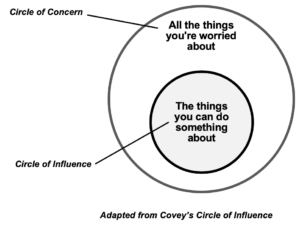
A legend of the world of management and business is Steven Covey. He wrote The Seven Habits of Highly Effective People (1989). The are some amazing insights for actors in his book (especially habit seven, if you’re someone who could improve your personal time management for example). Habit one, of the Seven Habits, is all about recognising what you can control
and what you can’t.

talking down the self talk

Covey argues that when we recognise concerns and worries bubbling up, we should stop and ask ourselves whether it’s something we can influence. If we realise we can’t, that it’s out of our control, then ask “why am I putting so much energy into that?”. Covey suggests instead that we invest our energy into things that we can control.

Read the rest of the article at Stage Milk…

7 Reasons to Love Self-Taped Auditions

by Amy Jo Berman

SELF-TAPE AUDITIONS

When it comes to the self-tape auditions, many actors have a love-hate relationship.

Why?  Why the hate and not the love?

There are so many reasons to LOVE self-tape auditions.

Let’s break them down.

Here Are 7 Reasons You Should Love Self-Tape Auditions:

Reason #1  Self-Tape Auditions Can Be Private

Sometimes, when you enter the room at a live audition, it can be shocking how many people are actually in that room with you.

Did you ever think: OMG!  Who are all these people?!  …All while you’re trying to put your best foot forward and WOW them with your talent.  All those eyes on you.  Yikes!

It’s very common to have not only the Casting Director in the room, but a Casting Associate, Casting Assistant, maybe even an intern.   And that’s just for a pre-read.

When you are at a callback, you are often in the room with all of the above, PLUS one or two (or more) Producers,  Directors, Writers…Sometimes even a network person wanders in. (Seriously, I’ve had that happen and it wasn’t even a network test!)

With a self-tape audition, it’s just you, your reader and camera person.  Not 12 sets of eyeballs on you.  Whew!  That’s a lot less pressure and a great reason to love self-taping your auditions.

Reason #2 – There’s No Casting Director in the Room for Self-Tape Auditions

Having no Casting Director in the room can be a good thing and a bad thing.  The good part goes along with all of the above.  Much less pressure on you when you don’t have the Casting Director, whom you’re trying to impress, right there, evaluating your every move (or at least that’s what you guys always tell me it feels like to you – we’re not all that bad really 😉

Read the rest of the article at AmyJoBerman.com…

Actors Beware of These “Manager” Contracts!

by Paul Russell Casting

When it comes to the profession of representing talent the profession of personal manager is unfortunately the most fraught with shady characters. Individuals operating scams that at worst defraud actors. At best create a lopsided arrangement. One that is less an advisor-n-artist partnership but where the “manager” is a self-serving predator. Managers are not regulated by actor unions and/or local and state government oversight as are agents. Yes, there are reputable, respected managers. Their industrious support of actors is overshadowed by opportunists tagging themselves unjustly as a “personal manager.”

The largest red flag demarcating a “manager” of questionable integrity from a reputable personal manager is the ethically challenged “manager’s” manager-actor contract.

Answers for Actors reviewed one such eyebrow raising manager-actor contract littered with dubious clauses. Binding terms that are not in the best interest of the actor.

For identification purposes this management’s operation will be given hereinafter the fictitious moniker Management Extraordinaire: M.E. as an abbreviation.

Answers for Actors calls, B.S. on such a broad, and open clause.”


Actors beware of the following.

Commission:

First some good news. Some industry respected managers collect 10 percent commission on actor salaries derived from projects of which the actor participates as talent. It’s the same percentage that agents collect as regulated by performing artists’ unions. A larger number of managers collect 15 percent. Not so good news? Being that there is no government or union regulation or oversight of managers a manager can collect whatever percentage they choose, that an actor is willing to sign away. Management Extraordinaire collects 20 percent. Above the norm. An actor going into an agreement with a manager should not part with more than 10 – 15 percent commission.

To Management Extraordinaire’s credit—unlike one greedy “manager”—they don’t collect commission from the actor’s survival job(s).

Bilking the Actor:

Slipped slyly into Management Extraordinaire’s terms for commission is this:

“Artist agrees to pay or reimburse Manager for all out-of-pocket expenses which Manager incurs from time to time on behalf of Artist.”

Answers for Actors calls, B.S. on such a broad, and open clause. The “manager” could claim anything as “out-of-pocket expenses.” Agents are not permitted to invoke such a swindle.

Read the rest of the article at AnswersForActors.net…

Pronoia and Willful Blindness

by Bonnie Gillespie

I have a question for you.

It’s about your setpoint.

Do you believe that someone is always running game on you? Out to get you? Taking advantage of you?

Or do you believe that everything is always working out for you? That even if something doesn’t go the way you want it to in the moment, the long-term best for you is what’s happening?

Here’s why I ask this: Over the past few weeks, we’ve had a CRUSH of customer service emails. Like, three times the volume of what we generally receive.

No surprise there; we advertised for the first time, invited hundreds of new people into our world, held a TON of free live trainings, and welcomed in the first class of 2020 for our enoughness membership.

That’s a lot of activity and with activity comes questions.

And while questions are expected, it’s fascinating to see the difference in tone.

Among the FAR more innocuous and typical, “I can’t seem to get my download of your audiobook to work. Please help?” (the fix is easy, BTW. We even spell it out right on the page from which you buy it. You can’t download it on a gadget, only on a computer using a web browser. And many people exhaust the link by trying so many times ON a phone or a tablet, which won’t extract a ZIP file… which we explain on the sales page itself… so… yeah), there are also the, “You’ve stolen my money. This link doesn’t work because you’re a crook. You’re withholding something from me. Tell me EXACTLY why this is happening and what you’re going to do about it,” ones. There’s, “Someone’s getting a better deal than I am; defend that to my satisfaction.” And there’s, “This reminds me of that one time someone ELSE did me dirty so that means you are too so you will PAY for my falling for it again,” which is truly confounding. Because different people. Different circumstances. Different time in life. Different YOU going through it all.

Yet when we are certain we’re getting the short end of the stick, we have VERY strong muscles for going right to the accusation, right to the, “See! I told you the world is filled with bad people doing bad things TO ME!” mindset… and we choose to be blind to the evidence that none of this is what’s *actually* going on.

It’s a phenomenon called willful blindness (and there’s an amazing book on this subject if you’re a geek like me and want to read more from Margaret Heffernan about all the things our brains will discount, disregard, and simply NOT SEE out of simple evolutionary efficiency). BTW, we ALL engage in this at some point in life.

I prefer pronoia as a setpoint, personally. This is the opposite of paranoia (everyone is out to get me) and instead focuses on all the ways things are working out for me.

Read the rest of the article at BonnieGillespie.com…

3 Strategies to Help Build Creative Intimacy

by Mihaela Ivan Holtz

Creativity requires you to stay present and connected with all that you are – your talents, skills, and vision, as well as your feelings, thoughts, and inspiration. Your most private experiences and aspects of your internal life all come together and, one creative moment at a time, they become your art.

As an artist, you know what it’s like when you merge with your art. You and your art flow together and become one. It almost feels like magic. You enter into a state of creative bliss and experience a true connection both to your powers of creativity and to all that you are.

Of course, in the midst of these moments of creative bliss, there are moments of the creative mess. You feel like you don’t know what to do or how to do it. Everything feels like an experiment and you keep making mistakes and repeatedly trying something new.

3 Strategies to Help Build Creative Intimacy

When you have the strength and courage to navigate the messy creative moments, you can eventually find your way back to creative bliss. It takes a lot to move through the creative challenges and into creative flow, however.

To get through the challenging moments that are part of any artistic career, you need to know how to stay present and connected throughout the whole process of making art or preparing for a performance. You need to be present in the face of all the wonderful creative experiences and you need to stay connected even in moments of frustration and confusion.

This process of staying connected to your art in both the good times and the bad times – and everything in between – is called developing creative intimacy.

Creative intimacy is vital as it allows you to make powerful art that is authentic and uniquely you.

As important as creativity intimacy is, it’s not easy to maintain such a state. It requires you to stay present and connected throughout your creative process – including your own limitations, your fears and doubts, and your relationship to the unknown.

So How Can You Help Yourself Build and Preserve Your Creative Intimacy, Despite All the Challenges?

As paradoxical as it sounds, you need to become more comfortable with what challenges you.

Read the rest of the article at Stage 32…