
What To Do When Your Confidence Just Isn’t There

by Eddie Ramos

Photo by Enrico Carcasci

Are actors egotistical? Are they narcissistic? Do they seek validation? If you answered yes to all these questions, then you’re kind of right.


But before you judge yourself or any actors you know, take a moment to understand what being an actor really means. 

An actor must take those traits and through a process of creativity translate them into one golden word: CONFIDENCE. 

The dictionary defines confidence as: a feeling of self-assurance arising from one’s appreciation of one’s own abilities or qualities. It’s the spice in life that allows actors to spill their guts to millions of people.

In a matter of days, through things like surrounding themselves with the wrong group of people—actors can go from possessing wild amounts of confidence to people who can barely look you in the eyes.

Without possessing confidence in themselves, actors face lackluster performances or worse might start to doubt their talent.

How Do I Know I’ve Lost It?

the breakdown .jpg

Low confidence can manifest itself in many ways and everyone’s different. However, if you’re like me the minute I found myself in a constant stream of negativity and judgment on my abilities I knew my confidence was waning. Not too long after, I struggled with my auditions, relationships with loved ones, and day to day activities. Some of the obvious signs are:

  •  Not believing in yourself and your abilities.
  • Not looking anyone in the eye.
  • Having a weak handshake or low energy.
  • Being nervous in social settings.
  • Not knowing your lines at an audition.

Becoming aware of low-confidence allows you to course-correct before the spiral inevitably continues.

Make Confidence A Daily Habit

Most people don’t understand how to stay confident. Take this scenario, do you start working on an audition, ready to give a kick-ass performance, only to psych yourself out in the room?

Read the rest of the article on The Modern Actor…

Talking Down the Self-Talk

by Stephen Walker

talking down the self talk

The most powerful influence over our feelings, thoughts and actions are our own words: the things that voice in our head says to us. We actors often find ourselves in our heads, stressed, overthinking and worrying… usually about things that are out of our control.

Relax though, you’re not alone. We’re all guilty – actors and non-actors alike. We all have things in our lives that concern us and worry us. We can worry about world peace, worry about Trump or worry about whether the casting director (CD) liked us in that audition we just did. Sometimes our worries become all-consuming: we wake in the middle of the night, find it hard to get to sleep or simply begin to question our decision to be an actor. However, usually, the thing that we focus on and put our energy into, is the thing that will grow.

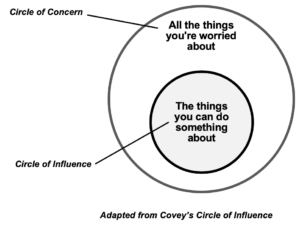
If we focus on our concerns and fears, there is a good chance that they will grow and become overwhelming or paralysing. In other words, instead of reacting to, or worrying about conditions over which we have little or no control (such as whether or not our audition was good), we can instead focus time and energy on things we can control and influence. One of the simplest yet powerful things we can influence, is the language in our heads.

A legend of the world of management and business is Steven Covey. He wrote The Seven Habits of Highly Effective People (1989). The are some amazing insights for actors in his book (especially habit seven, if you’re someone who could improve your personal time management for example). Habit one, of the Seven Habits, is all about recognising what you can control
and what you can’t.

talking down the self talk

Covey argues that when we recognise concerns and worries bubbling up, we should stop and ask ourselves whether it’s something we can influence. If we realise we can’t, that it’s out of our control, then ask “why am I putting so much energy into that?”. Covey suggests instead that we invest our energy into things that we can control.

Read the rest of the article at Stage Milk…