A Tour of Sweet Home Voice Over Studios with George The Tech Whittam

by VOPlanet

Professional Home Voice Over Studios

A sunny, custom built glass enclosed voice over booth with breathtaking outdoor views.  A state-of-the-art recording space where you peek over the mic and you are overlooking the sea. Working from a home voice over studio never looked so good. In fact, it is not accurate to call them “home” studios anymore. These are professional voice over studios for professional voice actors that happen to be in a home, and they sound as gorgeous as they look.

Like you, we at VOPlanet geek out over gear, especially when it is set up in such amazing spaces. So, we chatted with the expert: George “The Tech” Whittam. George is famous in the voice over community for (among other things) designing brilliant studios and audio chains for the top voice actors in the industry. He’s a good man to chat with about cool studios.

Howard Parker’s Studio 44 – Design by George Whittam 

Let’s talk about Howard Parker and his studio. You designed an amazing recording space. Just breathtaking. What was Howard’s concept going into this project?

Howard wanted his “last studio,” his best creation yet. Knowing Howard, though, it’s likely not to be his last. He wanted to have lots of light, and not feel too much like he’s inside a box. He also wanted to be able to see the beautiful cut-glass window on the exterior wall, that was in existence beforehand. Beyond that, the rest was left up to me. I wanted to keep the ceiling in the studio as high as possible and follow the vaulted ceiling line.

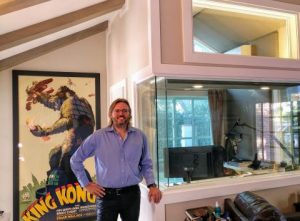
Howard Parker Studio 44 Designed by George The Tech Whittam. Image courtesy GeorgeTheTech.com.

What were the biggest challenges bringing Howard’s vision to life? 

First, finding a builder willing to take on something totally new, but on a smaller scale than a whole home build, isn’t an easy task. Many of the great builders/contractors I’ve used over the years have become too busy on large/big budget projects to take on something like this. Engineering the shape of the room and a way to support such a large glass opening was a bit tough and require collaboration with the builder, George Beavers. While I have visions and ideas for designs, it’s often the builder who is left to solve the problems of exactly how to build something. I was also concerned about the acoustics of the space, how it would work out with so much glass.

Read the rest of the article at VOPlanet Blog…

5 Tips for Heading Back to Acting School After a Break

by Ajarae Coleman

Article Image

Photo Source: Photo by Anthony from Pexels

Even if you’ve been out of traditional school for a while, there is something magical about this back to school time of year. The laid-back vibes of summer vacation are at an end, our days are getting shorter and cooler (in the northern hemisphere anyway), and we feel a little more motivated to buckle down and get to work.

If you’re an actor who has taken some time off from your training, you may be itching to get back to it. So, how do you decide where to go? Acting classes are a huge investment of time, money, and creative energy, and you deserve the best training for where you are in your career right now. Here are five steps you can take to decide what training is a good fit for you.

1. Determine your current career goals.
There are countless categories of acting training available—scene study, script analysis, improvisation, stage combat, audition technique, on-camera classes—these are just a few! When you’re researching the landscape of options, it’s easy to feel overwhelmed. So it’s imperative that you spend some time getting clear on your desired next step in this phase of your career. If your goal is to land a co-star on a television sitcom, then comedy and improv training could be great choices. If you want to book a national commercial, it’s time to find commercial technique classes in your area. If your dream is to work as a performer on Broadway, musical theater training might be a smart move. Narrowing your focus doesn’t limit you. Rather, it gives you much-needed clarity.

2. Get clear on your non-negotiables.
Once you pick a category for your training, it’s time to get even more specific. What other characteristics of your new acting school are important to you? Maybe you want to study with a teacher who also offers private coaching for auditions. Perhaps there is a specific technique you want to learn, like the Alexander Technique or the Linklater voice method. Or you’d like to find a large community of ambitious actors who are busy creating their own projects and inspiring one another. Dive a bit deeper and consider the full experience you wish to have with your next training.

Read the rest of the article at Backstage…

What To Do When Your Confidence Just Isn’t There

by Eddie Ramos

Photo by Enrico Carcasci

Are actors egotistical? Are they narcissistic? Do they seek validation? If you answered yes to all these questions, then you’re kind of right.


But before you judge yourself or any actors you know, take a moment to understand what being an actor really means. 

An actor must take those traits and through a process of creativity translate them into one golden word: CONFIDENCE. 

The dictionary defines confidence as: a feeling of self-assurance arising from one’s appreciation of one’s own abilities or qualities. It’s the spice in life that allows actors to spill their guts to millions of people.

In a matter of days, through things like surrounding themselves with the wrong group of people—actors can go from possessing wild amounts of confidence to people who can barely look you in the eyes.

Without possessing confidence in themselves, actors face lackluster performances or worse might start to doubt their talent.

How Do I Know I’ve Lost It?

the breakdown .jpg

Low confidence can manifest itself in many ways and everyone’s different. However, if you’re like me the minute I found myself in a constant stream of negativity and judgment on my abilities I knew my confidence was waning. Not too long after, I struggled with my auditions, relationships with loved ones, and day to day activities. Some of the obvious signs are:

  •  Not believing in yourself and your abilities.
  • Not looking anyone in the eye.
  • Having a weak handshake or low energy.
  • Being nervous in social settings.
  • Not knowing your lines at an audition.

Becoming aware of low-confidence allows you to course-correct before the spiral inevitably continues.

Make Confidence A Daily Habit

Most people don’t understand how to stay confident. Take this scenario, do you start working on an audition, ready to give a kick-ass performance, only to psych yourself out in the room?

Read the rest of the article on The Modern Actor…

Talking Down the Self-Talk

by Stephen Walker

talking down the self talk

The most powerful influence over our feelings, thoughts and actions are our own words: the things that voice in our head says to us. We actors often find ourselves in our heads, stressed, overthinking and worrying… usually about things that are out of our control.

Relax though, you’re not alone. We’re all guilty – actors and non-actors alike. We all have things in our lives that concern us and worry us. We can worry about world peace, worry about Trump or worry about whether the casting director (CD) liked us in that audition we just did. Sometimes our worries become all-consuming: we wake in the middle of the night, find it hard to get to sleep or simply begin to question our decision to be an actor. However, usually, the thing that we focus on and put our energy into, is the thing that will grow.

If we focus on our concerns and fears, there is a good chance that they will grow and become overwhelming or paralysing. In other words, instead of reacting to, or worrying about conditions over which we have little or no control (such as whether or not our audition was good), we can instead focus time and energy on things we can control and influence. One of the simplest yet powerful things we can influence, is the language in our heads.

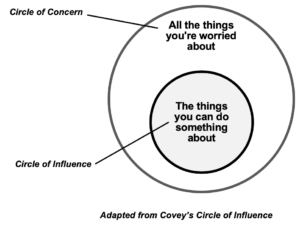
A legend of the world of management and business is Steven Covey. He wrote The Seven Habits of Highly Effective People (1989). The are some amazing insights for actors in his book (especially habit seven, if you’re someone who could improve your personal time management for example). Habit one, of the Seven Habits, is all about recognising what you can control
and what you can’t.

talking down the self talk

Covey argues that when we recognise concerns and worries bubbling up, we should stop and ask ourselves whether it’s something we can influence. If we realise we can’t, that it’s out of our control, then ask “why am I putting so much energy into that?”. Covey suggests instead that we invest our energy into things that we can control.

Read the rest of the article at Stage Milk…

7 Reasons to Love Self-Taped Auditions

by Amy Jo Berman

SELF-TAPE AUDITIONS

When it comes to the self-tape auditions, many actors have a love-hate relationship.

Why?  Why the hate and not the love?

There are so many reasons to LOVE self-tape auditions.

Let’s break them down.

Here Are 7 Reasons You Should Love Self-Tape Auditions:

Reason #1  Self-Tape Auditions Can Be Private

Sometimes, when you enter the room at a live audition, it can be shocking how many people are actually in that room with you.

Did you ever think: OMG!  Who are all these people?!  …All while you’re trying to put your best foot forward and WOW them with your talent.  All those eyes on you.  Yikes!

It’s very common to have not only the Casting Director in the room, but a Casting Associate, Casting Assistant, maybe even an intern.   And that’s just for a pre-read.

When you are at a callback, you are often in the room with all of the above, PLUS one or two (or more) Producers,  Directors, Writers…Sometimes even a network person wanders in. (Seriously, I’ve had that happen and it wasn’t even a network test!)

With a self-tape audition, it’s just you, your reader and camera person.  Not 12 sets of eyeballs on you.  Whew!  That’s a lot less pressure and a great reason to love self-taping your auditions.

Reason #2 – There’s No Casting Director in the Room for Self-Tape Auditions

Having no Casting Director in the room can be a good thing and a bad thing.  The good part goes along with all of the above.  Much less pressure on you when you don’t have the Casting Director, whom you’re trying to impress, right there, evaluating your every move (or at least that’s what you guys always tell me it feels like to you – we’re not all that bad really 😉

Read the rest of the article at AmyJoBerman.com…

3 Strategies to Help Build Creative Intimacy

by Mihaela Ivan Holtz

Creativity requires you to stay present and connected with all that you are – your talents, skills, and vision, as well as your feelings, thoughts, and inspiration. Your most private experiences and aspects of your internal life all come together and, one creative moment at a time, they become your art.

As an artist, you know what it’s like when you merge with your art. You and your art flow together and become one. It almost feels like magic. You enter into a state of creative bliss and experience a true connection both to your powers of creativity and to all that you are.

Of course, in the midst of these moments of creative bliss, there are moments of the creative mess. You feel like you don’t know what to do or how to do it. Everything feels like an experiment and you keep making mistakes and repeatedly trying something new.

3 Strategies to Help Build Creative Intimacy

When you have the strength and courage to navigate the messy creative moments, you can eventually find your way back to creative bliss. It takes a lot to move through the creative challenges and into creative flow, however.

To get through the challenging moments that are part of any artistic career, you need to know how to stay present and connected throughout the whole process of making art or preparing for a performance. You need to be present in the face of all the wonderful creative experiences and you need to stay connected even in moments of frustration and confusion.

This process of staying connected to your art in both the good times and the bad times – and everything in between – is called developing creative intimacy.

Creative intimacy is vital as it allows you to make powerful art that is authentic and uniquely you.

As important as creativity intimacy is, it’s not easy to maintain such a state. It requires you to stay present and connected throughout your creative process – including your own limitations, your fears and doubts, and your relationship to the unknown.

So How Can You Help Yourself Build and Preserve Your Creative Intimacy, Despite All the Challenges?

As paradoxical as it sounds, you need to become more comfortable with what challenges you.

Read the rest of the article at Stage 32…