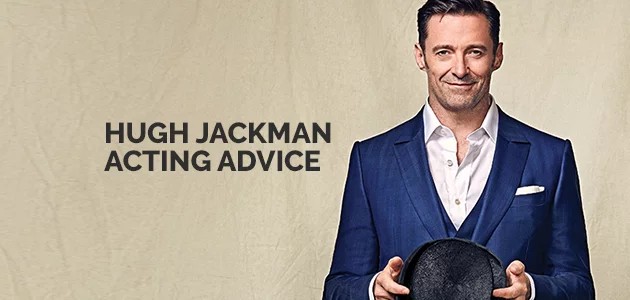
Hugh Jackman Acting Advice

by Patrick Cullen

Off the back of the extraordinary success of The Greatest Showman, Aussie acting legend Hugh Jackman sat down with the crew of the BAFTA’s and dished out some excellent acting advice. I have compiled the biggest takeaways here for your convenience. Get amongst it.

‘Film is the directors medium, find out who the director is.’

Hugh’s first point in this interview is about the director, trust and collaboration.

“You need to be able to trust that director, and know that the director is going to push to get the best out of you…They give you freedom in these boundaries, kind of like parenting really”

Especially in film, your character lives, breathes and dies at the hands of the director. You as the actor have to be able to trust them and trust their vision. Importantly that they need to know what they want from you and are ready to work with you to achieve it. Research the director before you take a role, look at some of their previous work, grab a coffee with them and get a vibe. If you feel like it’s weird or you don’t connect, it probably isn’t going to work out.

‘The last thing you ever want in front of the camera is doubt’

The viewing audience on the other side of the camera are like circling sharks, but instead of smelling blood in the water, they smell doubt in the performer. Jackman says the last thing you ever want in front of the camera is doubt. A performer who is unsure of themselves, who has not made choices, who cannot take direction is going to really struggle. What this comes back to is doing the preparation. It is great to be spontaneous, but not so great to be unsure of yourself.

‘Be friendly to everyone’

“In the Australian film industry everyone talks to everyone, if they’re not making fun of you they probably don’t like you… I much prefer to feel like we’re in it together”

Particularly in Australia, but I think this applies worldwide – be friendly to the cast and crew around you. No one likes a diva and in the modern industry, that sort of behaviour is just completely unnecessary. Jackman is right about Australian sets too, if the crew is treating you with too much respect it’s highly likely you’re not the most loved person on set. Being a team player is a key part of being an actor, so try and fit into the culture of your film set as much as possible. Everyone is working towards the same goal, to create a great film.


Read the rest of the article on Stage Milk…

8 Ways to Fight Disenchantment

by Ali Wills

Not all of us have been there, but many of us have.

This is the first audition you’ve had in months, you’re super nervous because you need this money to make ends meet and hate your survival job (ok, maybe you don’t hate it, but you’re becoming known for it and not as an actor) and you’re ready to be on TV already!

This is your shot—to show your agent that you’re bookable for lead roles, and feel good about yourself as an artist; like you’re the real deal out here really doing it.

Fast forward, you’re in the audition room, for your one liner co-star role. You try to make small talk with the casting assistant who doesn’t seem to be feeling you. You say your line, and the assistant ends the audition with the fatal blow of  ”Thanks for coming in” and your day goes to crap from there. 😩

After this cycle goes on for the umpteenth time, you’re completely over it and begin to feel that creeping feeling of disenchantment. 

I remember one day after my second move to New York City, walking to my survival job in Chelsea and being completely miserable. I looked around and saw everyone on that street looked just as miserable and began to wonder, is this what it’s all about: Feeling disenchanted and disappointed? Thankfully, the answer is no.

Here are the lessons I’ve learned on how to avoid becoming jaded and fighting disenchantment.

1. LEARN WHAT THAT ADVICE YOU KEEP HEARING REALLY MEANS.

I know I’ve heard it a million times, “Enjoy the process,” but I never quite digested what that meant. Without respecting that there is a process to any goal, you’ll never make it, let alone feel good about where you’re going. By definition process means a series of steps to attain an end, so the process of going broke, going back home, walking 5 miles from one city to another, shaving your head for a role, then not having the money to get new headshots, being dropped by the agent that scouted you, and throughout all of this holding on to you self worth, is all, technically, a process to landing bigger roles.

2. GET OUT OF YOUR OWN WAY.

Ask yourself, are you sabotaging your success and your reputation? The whole week you were given to memorize those sides, did you just leave them in your bag because you were confident that you knew the two lines, only to fumble through them in the audition? Be honest with yourself and recognize that you are the CEO of your business. Casting directors will choose actors known for their reputations of consistently delivering good work.

3. DEAL WITH YOUR INSECURITIES.

This industry is hard. Everyone is charming, funny, talented, outgoing and any insecurities you have will be magnified. Your self esteem will take a big hit if you aren’t secure and this industry will not coddle you. Realize there is an ebb and flow, there are enough jobs if you’re patient and persistent, so don’t compare your attributes.

Read the rest of the article on The Modern Actor…

The Art of Showing Up: 7 Things Creatives Must Practice to Succeed

by Joey Madia

The Art of Showing Up 7 Things Creatives Must Practice to Succeed

The most important thing in life is showing up. I am blown away by your ability to show up. (Keanu Reeves, Hard Ball)

Prologue

Primarily being a writer, and one who does a lot of historical research, I spend a lot of time alone. So, when I’m hired as an actor, director, storyteller, or teacher, it gives me an opportunity to test my philosophies of keeping motivated and inspired and doing the same for others.

For three weeks in June I toured as Marxist revolutionary Che Guevara in a form called Modern Chautauqua, which involves about 18 months of intensive research, the writing and performance of a 45-minute monologue, and 20 minutes answering questions from the audience, first as the historical persona and then as the scholar-performer. It also involves conducting related workshops.

During the tour, I was able to test the principles behind Showing Up. As I get older, I want to be out acting, directing, and teaching more than ever before. Which means making the most of opportunities.

I was surprised and energized by the effect of practicing the seven principles behind fully Showing Up shared in this article. Several opportunities have come my way, and the energy of what these principles allowed me to accomplish has yet to diminish.

Being asked to write about it for Stage 32 is proof enough of that.

So here’s what I practiced, based on 30 years of putting myself out there as a Creative.

1. Learn to Say Yes to Life

The Art of Showing Up 7 Things Creatives Must Practice to Succeed

Six years ago I received an email that put this essential aspect of Showing Up foremost in my career. I was offered third lead in a remake of a classic horror film. It meant juggling my editing business, theatre company, and several writing projects while being on location for three weeks, shooting for long hours. Without hesitation—and quite out of character—I said yes. It was a knowing that this would be about more than just doing the film. Turns out, I was right. So pay attention to intuition when making decisions. The juggling wasn’t easy—I fell asleep at the wheel for a split second driving home for a few days after being awake for 29 hours—but the experience opened several doors. My saying yes to the three-week tour as Che had similar sacrifice and success.

Saying Yes to Life means being able to audition anytime, anywhere, and giving it all you’ve got. By audition, I mean acting auditions, pitches, video chats, interest meetings—any time there’s an opportunity to show your stuff and score a gig. As I’ve said elsewhere, it might mean dressing up in full pirate regalia and auditioning in a kitchen in a small town for strangers (I did that—it’s worked out well.) Point is, let no opportunity come and go without giving it 100%.

2. Be Your Most Authentic Self, No Matter the Risk

Authenticity, a concept I learned from Brené Brown, is crucial. In this time of social media trolling, othering, and at times disingenuous practices of PC behavior—which often fly in the face of good, honest art that provokes thoughtful, respectful discussion—it is harder than ever to be Authentic, because the risks are greater and the use of Persona for personal and professional gain is everywhere.

But Authenticity is essential to Showing Up. Start by knowing why you’re there. What are your motivations? We of course need money to eat and for the value it assigns to our work, but if that’s your only reason, it’s a guarantee you’ll be In-Authentic. You’ll say what they want to hear, compromise your work to please, and you won’t be particularly memorable. You’ll be another in a long line…

A core piece of being Authentic is seeing every chance to work—to be in front of an audience, cast, or group of students; to have someone read or see my work; to have someone ask my advice—as a Privilege. A lot is made of established actors believing their current job is their last one. But that’s not all I’m saying. It’s about Fearlessness in being the Real You. Don’t Pretend. Say what’s on your mind—which of course needs to be well thought through and based on the tangible facts and skill sets you’ve accumulated through learning your craft—and do it because you are making the most of this opportunity, because you know it could have gone to someone else.

Practice Don Miguel Ruiz’s “Four Agreements.” The first is: Be Impeccable with Your Word. Don’t gossip, say what you mean, and follow through, and know that words have power. Choose them wisely.

Read the rest of the article at Stage 32…

Reclaim Your Worth as an Artist

by Mihaela Ivan Holtz

Reclaim Your Worth as an Artist

Reclaim Your Worth. Reclaim Your Art.

As an artist, you need a powerful, resilient, yet flexible and fluid sense of self-worth. Self-worth keeps you connected to your creative energy. When you feel in touch with your self-worth, you can make art that you believe in. You trust the value of what you create – its message, meaning, power, and purpose.


A real trust in your creativity begins with accepting yourself and all that you are. Connected to yourself, you’re able to maintain a solid belief in your own value, despite your perceived strengths or weaknesses, beauty or shadows. Grounded in your sense of self-worth, you don’t question what you create, you just do. You don’t get stuck worrying whether your art it will impact your audience, you just trust that it will find its way to those who will appreciate it. You don’t try to measure its value, you just feel its value. And, you don’t compare yourself with what others are creating, you just get to work and make your imprint into the world.

When you are in this mindset it’s not about proving anything. It’s about living and playing in the fantasy realm. It’s about bringing your daydreams to life. It’s about engaging in your craft and your pure self-expression. Fully trusting your creativity, you can give clear voice to unanswered questions, the different complex human experiences, or the unique depth of your characters.

Yes, all of this is possible when you’re in touch with your self-worth. It’s a simple yet powerful way to live, but it can feel so difficult to attain. In truth, it’s not about attaining anything at all…

Self-worth is not about who you are, it’s about what you do with what you are.

Reclaim Your Worth as an Artist


Self-worth is not an entity. It’s not something you possess or can lose. Rather, self-worth is something you can have access to. It’s something that flows forth when you’re in a relationship with all of who you are – your greatness, your messiness, your unfinished parts, your craziness, your brightness, and your darkness.

To embrace your sense of self-worth is to embrace your most authentic self and your most authentic experiences.

Self-worth is not about never feeling insecure or scared. It’s not about avoiding feelings of shame, rejection, or about never feeling unseen or unloved. Self-worth is about trusting that despite all that, you still have value. Therefore, you can express your creative energy, show up, and bring your art in the world.

Regardless of your experiences, self-worth protects you from letting anything stand in your way of being creative. It helps you see that, in spite of anything you might have been through, you are a human being who has inherent value and who has an ability to add value to the world. Supported by your self-worth, you can connect to your full humanity and access real courage, determination, and power to pursue what you want to create.

How Can You Cultivate Your Self-Worth in a Career That Can Tear You Apart?

Read the rest of the article at Stage 32…

The Introverted Actor Survival Guide

by Emily Liu

Introverted Actor Survival Guide

Hi, I’m an introvert and an actor (yes, we exist).

For me personally, this can make my chosen career path extra challenging at times (yes, the financial instability and cut-throat competitive industry wasn’t enough already). Acting is a team sport and far from lacking in social interaction. From networking, auditioning, rehearsing, performing, opening nights and closing parties, drama school and acting classes, you can bet most of your time will be spent around and with others. The long hours required of rehearsals, shows or film shoots is tiring for anyone, but for introverts can be especially draining.

There is a common misconception that introversion and extroversion dictate how outgoing a person is, but actually they describe how people gain energy (or recharge their brains!) For introverts, their energy is gained from within themselves and extroverts through others. This means that introverts recharge through alone time and are drained after social interactions, while the opposite is true for extroverts. While introversion and extroversion aren’t necessarily personality types (not all introverts are shy and extroverts outgoing), there are traits that are more common with each type. For introverts, there is a correlation with being quieter, a home-body and sometimes shy and socially anxious. As someone who identifies with all those qualities, I do feel I’m very much qualified on the introverted front. However, after a few years of braving various acting terrain I have developed a better understanding and knowledge of self-care for my introverted self. Here are some tips that have worked for me.

#1 Set boundaries and don’t always feel the need to ‘keep up’

Saying ‘no’ can be difficult and the desire to keep up with others and fit in with your peers or fellow cast and crew is strong. Parties and social gatherings seem to be particularly abundant in the arts (I’m looking at you drama school). Despite partying being the last thing I felt like doing after some mammoth weeks at drama school, I would felt guilty and stressed about not going to social gatherings, worrying about ‘falling behind’ socially. However, I eventually learnt to know and respect my limits. This meant sometimes choosing to get an early night or opting to organise a one-on-one coffee catch-up with a friend instead. It also meant that when I did choose to go to parties or events I enjoyed it much more because I’d chosen to be there mindfully so it was more enriching than draining. Looking after yourself means you can be a happier and more productive human and actor.

Read the rest of the article on Stage Milk…

How to Thrive as an Unemployed Actor

by Douglas Taurel

Acting is the only profession in which you will always be in a constant state of unemployment, always,  you will always be looking for work. You book a TV series, a film, a play or a tour, and when that project ends and it will end at some point, you’ll need to find work again. This is the harsh reality of being an actor but you can not only survive in this constant state of unpredictability, you can thrive. 

The key is to having a goal, having something to aim at. During times of unemployment, goals support and protect us. Goals keeps you sharp and they opens doors for you but most importantly, they give you a purpose as an artist.  You need a goal that inspires you to do more, and to improve every single day. Even if it’s only by a small percentage.  Be a better actor today than you were yesterday. Strive to do more today than what you did yesterday. 

Sitting around waiting to be booked on an acting job, or hoping that your agent or manager finds you work, is aimless and hopeless. And is what causes such large amounts of depression in actors.  You feel like you have no control over your artistic life but you do have control. You have so much more control than you think. 

Go to work on a monologue that needs to be sharpened, learn a new monologue, learn twenty monologues or create a project for yourself. Always be improving and creating every single day that you call yourself an actor. It is not only the best strategy, it is the only strategy you have. 

Improving your craft as an actor gives you a strong sense of purpose and direction, it invigorates you. It keeps you moving forward towards something a target, and that action will always open doors for you – and there’s a practical reason for this. 

Read the rest of the article at DouglasTaurel.com…

How Connecting To Reality Can Further Your Creative Dreams

by Mihaela Ivan Holtz

How Connecting To Reality Can Further Your Creative Dreams

As an artist, you live in a dreamworld. It’s a world filled with creative ideas, passion, and fantasy. In that world you meet characters, you hear music, you envision the stories that you want to create.

You love your dreamworld. It’s where all your creative ideas are born and where your big career dreams come to light. This is where you feel most at home.

Living in the dreamworld comes naturally, but that might mean that reality feels like a strange and challenging territory, for you.


The arts world is a particularly big reality to take on. It’s a world filled with uncertainty, unknowns, and competition. Rejection lurks around every corner. It can take a lot to be seen and valued for your real worth. And then there’s the potential for mistreatment and abuse…

So, you may be inclined to avoid reality – not only because you love your dream world so much, but also because the arts world can be harsh and challenging.

Is Avoiding Reality Actually Helping You Achieve Your Creative Dreams?

What would happen if you dared to see and face reality? What if reckoning with reality could move your artistic career forward? What if there is power in working with the reality?

It’s important to understand that even if you deny reality, reality doesn’t go anywhere. Whatever you wish to avoid is still there to challenge you. In fact, being in denial makes you less able to face your challenges. It can make you more emotionally reactive, overwhelmed, or terrified of the things that you need to face. Denial steals your ability to consciously work within reality. When ignored, reality has a way of taking over and controlling you.

In this emotionally clouded place you can lose your connection to your talents and skills. You’re less likely to put your efforts where they belong. It becomes harder for you to see possibilities and opportunities as they emerge.

There’s a common misconception that your artistic dreamworld needs to be at odds with the practical, mundane, difficult aspects of life. In fact, it is possible to live in your artistic realm while staying grounded in reality.

When you acknowledge and work with reality you become actively engaged in building your career dreams and deepening your creative life.

How Can You Help Yourself Stay Grounded in Reality While You Still Honor Your Dreamworld?

Read the rest of the article at Stage 32…

Why Am I NOT ‘In-The-Moment’?

by Daniel Bradford

‘Being In the Moment’

Most actors began their journey by getting high – not in the pharmaceutical sense but in the raw, natural experience of ‘flow’ and ‘self-transcendence’. It’s the kind of natural high that comes from the confluence of certain conditions, allowing one to completely let go of one’s ego and sail into the void of effortless being. One could even say that many modern drugs seek to trigger this same kind of experience artificially. A loss of self, an alteration in consciousness, a letting go of the doing mind into the being mind, the allowing mind.

You might not know it or even remember it consciously, but chances are there was a time in your past, early on in your creative journey, when you experienced this kind of high. And you’ve been chasing it ever since. Of course, there are other reasons people start acting – fame, validation, love – and indeed those egoic tendencies are likely worming their way into your intentions too. But, those who really love the art began their journey in a moment of real self-transcendence. We call this experience being ‘in the moment’.

During this experience, we had no trouble concentrating or focusing on what was most important. In fact, the very possibility of not focusing would seem like a distant possibility. One feels both completely in control yet at the same time that control itself seems completely irrelevant. Everything is simply happening on its own as if we were merely a conduit for something greater to work through. Yet try as we might, we rarely find our way back to this state of being truly in the moment.

From Self-Obsession to Self-Transcendence

Like many things being in the moment isn’t necessarily a black and white issue. The journey to full self-transcendence could be seen as a spectrum. With one being more or less present and engaged with the conditions that eventually lead to the full peak experience itself. That being said, there is a clear experiential difference once one does tick over into the various degrees of the ‘self-less’ world.

Read the rest of the article at Mindful Acting…