Email Marketing

by Carrie Olsen

Voice actors reach out to me all the time and ask, “How do I book more voice over work?”. It actually makes sense if you think about it. After you get started, learn all you can skill-wise, the next logical step is to wonder how to get a job doing voice over work. If you look around my blog you’ll find all kinds of resources on things that you need to be prepared for voice-over work.

I tackle everything–from areas you need to build up so you can have a solid voice over foundation, a successful business, and make a living doing voiceover work to technical how-tos on how to get a good demo made,  best practices for auditioning, and programs on booking e-learning narration work.

How to Book Voiceover Work: Do Email Marketing

I want to spotlight one specific method for making contacts and turning them into paid voice over work: email marketing.

What is email marketing?

As it pertains to a voiceover business, email marketing is doing focused, targeted, personal outreach to clients or potential clients who are likely to hire you for voiceover work.

These clients aren’t necessarily going to hire you immediately, and that’s okay because that’s not the goalThe goal is to build relationships.

Let’s get this out of the way: This is a long-term process. The idea isn’t to send out 50 emails, book 50 jobs, and be instantly successful. The idea is to use a long-term strategy to build solid relationships so that when these prospects need voiceover help down the line, you already have an “in”. You’re already top-of-mind. They already feel comfortable with you and a partnership comes naturally.

How do you do email outreach so that you can build strong, natural relationships with people who have the potential to hire you? Let’s break it down.

Steps in Doing Email Outreach to Build Strong Relationships

1. Identify your target market.

  • The first thing is you need to know is who it is that you’re targeting. if you check out my Book More E-learning course, you can learn all about how to target e-learning clients. But if you’re interested in commercial work or explainer videos or other corporate narration type jobs, your outreach is going to look different.

Read the rest of the article at CarrieOlsenVO.com…

Does A Voice Actor Need A Niche? Here’s The Truth…

by Rachel Alena

I know. You read it online.

A VOICE TALENT MUST HAVE A NICHE! Well, I don’t always agree. Here’s why…. 100% True story… Last month, I met a newbie voice talent and we chatted. Here is how the conversation went down:

VO Newbie: “I’m so excited! My goal is to become a full time voice over talent. I already have my niche. I plan to be a children’s educational narrator.”

Me: “That’s a very specific niche. Would you consider broadening it?”

VO Newbie: ‘Nope. I’ve researched it online. A voice talent must have a niche.”

Me: “Well, it’s just that…with your strong British-Swedish mixed accent…and such a very specific niche…you might be limiting the amount of work you can obtain in the beginning. Broadening your niche might give you more opportunity to reach your goal of working in VO full-time.”

VO Newbie: ‘Nope. I’ve read that you should have a niche and that’s my plan. Children’s educational materials it is.”

Creating a niche is a fantastic way to become an expert by focusing on one area! And, with so many voice acting genres, you’re likely to have natural stronger talents in specific areas. Having a niche is great for marketing, too.

Here’s why not….

Less opportunity in the beginning

A niche such as ‘children’s educational narrations’ has specific clients. There will be opportunities in all genres. As a new voice talent who is playing the audition game you may find yourself waiting for opportunities.

Limited skill set with less to offer potential employers

Here’s a real-life example.

One of my first jobs for Delta Dental was to narrate 2 enrollment manuals…yes…those big thick books about benefits. This type of job was considered ‘industrial’ voice acting, such narrating as training materials.

Then, they asked if I could I narrate commercial material. Yes! Commercial voice acting was in my skill set so I could do those jobs, too. As a result, I now narrate commercial style videos for them.

Read the rest of the article at RachelAlena.com…

The Voiceover Negotiator (Establishing & Defending Your Voiceover Rates)

by Peter K. O’Connell

Some voice talent come into the voiceover business with blinders on…all they see are microphones, scripts and money. The business part they kind of “poo-poo” away dismissively, only to find themselves later to be playing catch up or out of the business entirely.

There are lots of books and videos and classes and seminars on all this voiceover business stuff.  Today, I thought I’d share my perspective on how to establish rates and execute negotiations after almost 40 years in voiceover. This isn’t all inclusive (you have to PAY for that 😉 ) but I will share some of what I feel are key points.

The business part of voiceover starts almost immediately, when you get your first job. Say it’s a commercial for a local bank…a local bank that has multiple branches across your state. It’s going to be on the radio and it’s :60 seconds. The client who offers you the job is a video production studio doing the production and hiring of the VO talent.

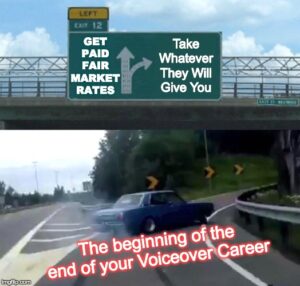
The studio offers you $50 for the gig.

Boy are you excited, first paying gig, heard across the state! All my family will hear it! This is my big break…here we go!

The excitement is understandable and natural.

SFX: Splashing a bucket of cold water on the new voice talent

Slow down there, Secretariat! Don’t jump into the studio yet.

That $50 fee is WAY too low for a regional radio spot.

If you accept the spot for that rate, you’ve established yourself as a VO who works way below rates and trust me, the studio KNOWS the REAL going rates for voiceover.

Read the rest of the article at Voxmarketising…

CA’s AB-5: A Legal Expert (and Voice Actor) Responds

by Dave Courvoisier

This is the part of interactive journaism I love.  Blogging isn’t exactly journalism, unless you happen to be a life-long journalist; then I think it qualifies.

And to qualify, a journalist has to be willing to go the extra length to make sure he gets the story right in the end.  I think with today’s addition to the question about AB-5, the facts are coming clear.

Peter Marx, a long-time member of the LA legal community, and now a voice actor too, wrote me in response to last week’s blog about AB-5.  He was glad I brought the issue to the fore, but had the courtesy to school me a little on the facts.

Thanks, Peter!

Read below to see his unedited response to me.

CourVO 

Dave,

I’ve been reading your blog for the last year or so, and appreciate that you share your views. I write to suggest, respectfully, that certain aspects of your post on January 2 about California AB 5 may be a bit misleading, or at least result in unnecessary concern. I have always found the VO community to be supportive and helpful, and what follows is offered in that spirit.

By way of background, I am an LA based voice actor, and though I’ve been around for awhile, as a practical matter I’m relatively new to the field. I have also been a member of the California Bar for over 50 years, and while now pretty much retired, one area of focus in my practice was employment law. I still serve as a mediator, and over the years have mediated countless cases where the primary issue was misclassification, i.e., did management misclassify a worker as an independent contractor rather than as an employee.

In 2018 the California Supreme Court decided Dynamex Operations West, Inc. v. Superior Court, which substantially affected the ability of employers to classify workers as independent contractors. (Pursuant to the court’s opinion, Dynamex appears to have a business model similar if not identical to Uber, the main difference being that Dynamex transports packages rather than people.) The Dynamex opinion is somewhat limited in its application, but in adopting AB 5 the legislature stated its intent to “codify … Dynamex and … clarify the decision’s application in state law.”

Read the rest of the article at CourVO.com…

Have a Recording Studio On the Go

by Patricia Lopez

If you work from home, it is inevitable that you will get emails or calls relating to your job ALL THE TIME. Now that it is the season to be jolly, of course you would want to have fun with your friends and family. Even though you are in vacation mode, there would be job-related stuff that would be very hard to ignore. For example, while out of the country, you receive an email from your agent requesting you to send an audition for a gig that you have been praying for. Of course, you will spare a bit of your time to record but the problem is, you do not have your portable recording booth with you. Or maybe, you are just not in your studio and a pick-up for a previous project is needed ASAP, what do you do?

How would these apps help me with my work?

Who leaves their house without their phones, or their tablets nowadays? Thanks to the technological advancement, you can both enjoy being at the party, and not worry about not sending that audition demo! Mobile phone applications might just help you out! If you are a voice actor who’s always on the go, download one of these apps, A.S.A.P.

These apps can let you have a work-life balance. Here are five applications that you can use to record, and edit audio when you are not on your home studio:

AudioMaster Pro

(Available on iOS)

AudioMaster Pro lets you choose between fully adjustable 6 band or presets of 3 settings per genre. This gem will help you put  the final touches on your audio production. AudioMaster instantly maximizes the volume and enhances the sonic characteristics of your recording.

“Our audio algorithm automatically adjusts levels and gives a general sweetening of the mix. Think of it as the difference between a good-sounding mix and a louder professional sounding finished master.” – Future Moments.

AudioMaster Pro lets you export, save and share anywhere. The app is also Audiobus, IAA and AU compatible. It can also be exported in your choice of wav, m4a stereo or mono. AudioPro Master can be used for Podcasts, Music, Voiceover, etc.

You can check out AudioMaster (not Pro,) if you want to try first before buying.

BIAS AMP 2

(Available on iPad, iPhone)

BIAS AMP 2 Mobile is a professional virtual amp designer that offers replications of 36 of the best vintage, modern and boutique amps in rock. The app lets you create new sounds by designing your own amplifier, lets you swap out tubes, preamps, power amps, transformers, tone stacks, cab, and microphones.

BIAS AMP 2 Mobile has new features compared to the first version. The new features include a powerful new user interface, new preamp and power amp modules, tubes, tone stacks, Blues and Bass amp packs, new Dynamic Tone Control, new speaker cabinet module with multi-mic capability and open/closed back cabinet emulation and much more.

The app boasts complete, accurate and versatile component-level amp modeling; factory categories that allow you to organize amps by music genre and sonic impact (clean, blues, glassy, crunch, metal, acoustic, and bass); customizable preamps, tone stacks, power amps, transformers, cabinets, and mic selection and placement, and a whole lot more.

Bias AMP 2 is also available on desktop.

Voice Record Pro

(Available in android and iOS)

Voice Record Pro is developed by BeJBeJ Apps. It is a professional voice recorder app made available in android and iOS. It allows you to record voice memos and on-site sounds at unlimited length with configurable quality.

Read the rest of the article at The Voice Realm…

I Like That Old Time PUNCH & ROLL (Apologies To Bob Seger). Here’s Why & How To Do It …

by James Romick

The term Punch & Roll stems from those nearly bygone days of multitrack music recording on those huge 16- and 24-track analog tape machines used to record Bruce Springsteen and the E Street Band in recording studios such as The Power Station, The Hit Factory and The Record Plant.

The term Punch & Roll is really a misnomer, though.

Technically, it should be called Roll & Punch, because that’s the order in which the process is performed.

The recording engineer would jog the tape reels back a bit to get a pre-roll, then roll the tape, and the performer would punch-in at a certain point, either as a new take (and continuing on with the recording) or to make a correction in the middle of some previously recorded material.

In either case, the previously recorded material was recorded over, erased from existence, never to be saved for posterity.

And that, my friends, is the simplest example of destructive editing – newly recorded material replacing and erasing previously recorded material.

So, why the name Punch & Roll?

Well, Roll & Punch just doesn’t readily trip off the tongue, in much the same way that Roll ‘n’ Rock collides as just wrong in the brain. Duh! It’s Rock ‘n’ Roll, dudes and dudettes! Hence: Punch & Roll.

DIGITAL AGE P&R

Fast-forward to the digital age.

Nearly anyone with a computer, a DAW (Digital Audio Workstation) installed on said computer, some relatively inexpensive professional recording equipment (microphone and preamp), and a sound deadened space (a padded, walk-in closet for instance), can have for themselves a home studio in which to record their auditions, podcasts or audiobooks.

Therefore, being a voice talent nowadays necessitates having some (more than basic) audio engineering skills, such as setting good input levels, possibly processing and mastering your files (using FX plugins like EQ and compression), and of course, using Punch & Roll to correct mistakes or mis-takes as the case may be.

Almost all DAWs now have P&R functionality. But the way they achieve it can widely vary.

Audacity and Adobe Audition, for instance, have only recently implemented their own versions of P&R. Audacity is still a destructive editing DAW (explained in the first paragraph), so whatever punch-ins are performed overwrite and erase previously recorded material. And that can be frustrating if the punch point isn’t hit dead on, often due to computer latency issues.

Read the rest of the article at Voice-Over Xtra…

Twitter For Voice Over Actors

by Anthony Pica

Hello, and welcome to A VOs Journey podcast. My name is Anthony Pica, and this show is all about helping the new and upcoming voiceover artists grow their business and sidestep all of the crazy things that I seem to step on. Well, today was a great day so far, but it got batched up. I was trying out a new service called restream doing my live video, and it did semi-okay, but on the other hand, I wasn’t live in certain places, and I was live on other sites, so I had to go back and do different shows. So to make a long story short, I wasn’t able to get the file that I wanted for the podcast. And you know, I think Twitter is going to serve all of us incredibly, and I’m going to talk about it. All right, let’s do it.

Don’t be afraid to try new things and don’t be scared to fall flat on your face just like I did today because it was interesting if you decide to go live in multiple places using restream, make sure that you have all of the different things figured out. You log out and log back in to make sure that everything is up to date. Um, so I am paying for restream, it is about $50 a month. And uh, I like the service because it’s going to allow me to go live on Twitter, on Facebook, and both my public page as well as the private group and the YouTube page. And then, of course, with my phone, I can go live on Instagram so that, you know, and I want to do that every single day because right now, you know, I go live every day on YouTube, but the other channels not so much. 

And I think for me, creating the content like that every single day on all those channels, it really, really, really, really, really helps so that I’m not going back and forth a million times trying to do all of this stuff. So anyway, that’s what’s going on. As I said, it worked, but I think I have it figured out at least enough to get going for tomorrow at one o’clock. 

But anyway, today I want to talk about Twitter, and I am in with Twitter. Again, it has been a while. I think most of us, we all know about Twitter, but probably a lot of us don’t use it or don’t use it much. Some people have done well on Twitter, but I think because of Instagram and because of Tik Tok and all of these, you know, social sites that are in your face regularly, it’s one of those things where Twitter just kind of is, is there, I mean it has grown. 

Read the rest of the article (or listen to the podcast) at A VO’s Journey Blog…

Are You In Voice-Over Career Level One, Two Or Three? Advice For Where You Are NOW …

by Dan Hurst

I’m pretty fed up with the voice-over business.
No, not doing voice-overs. I love that! And I adore my VO clients!
But some periphery businesses that attach themselves to this industry have gone Bell Curve batsh** crazy.
The vast majority of businesses in this industry are high class, dependable, necessary companies that operate with integrity and in the best interests of voice talents and their clients.
However, there are a few on the ends of the Bell Curve that are a drag and an embarrassment to the honor and wholeness of this business that the vast majority of us love so much.
I suppose I could say the same about voice talents.
We’re all discovering who they are, and who they are not. This business has gotten large enough that it’s time we begin to understand its immensity and how we all fit in – or if we do.
CATEGORIZING VO CAREER LEVELS
The nearest business we can compare ourselves to is stage and screen acting. We are, after all, voice actors. In fact, many of us crossover into both disciplines. And the businesses that serve us are similar to the businesses that serve the physical actors.
With that in mind, it’s time we begin to understand how the immensity of our community breaks down. It does actually break down pretty much the way the theatre and screen actors industry separates.
I see our industry of voice talents as being divided into three groups. While there are exceptions to every category, I think this helps explain the state of our business.
AMATEUR / HOBBIEST
First (and foremost), there is the amateur or hobbiest level. It is where we all started.
I can remember in my early radio days when I was expected to voice a spot at no charge for a radio client. I did it because it was my job. And I remember the thrill of a client telling me that the spot I voiced was getting great results.
That was enough for me. At the time.
By far (I’m guessing here. I don’t have the numbers, but it makes sense), the largest group of voice talents is the spectrum of talents who are doing this for free or minimal charge.