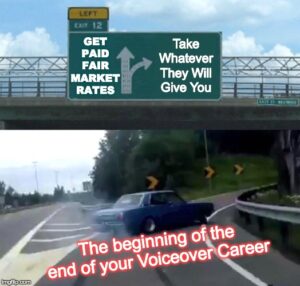
The Voiceover Negotiator (Establishing & Defending Your Voiceover Rates)

by Peter K. O’Connell

Some voice talent come into the voiceover business with blinders on…all they see are microphones, scripts and money. The business part they kind of “poo-poo” away dismissively, only to find themselves later to be playing catch up or out of the business entirely.

There are lots of books and videos and classes and seminars on all this voiceover business stuff.  Today, I thought I’d share my perspective on how to establish rates and execute negotiations after almost 40 years in voiceover. This isn’t all inclusive (you have to PAY for that 😉 ) but I will share some of what I feel are key points.

The business part of voiceover starts almost immediately, when you get your first job. Say it’s a commercial for a local bank…a local bank that has multiple branches across your state. It’s going to be on the radio and it’s :60 seconds. The client who offers you the job is a video production studio doing the production and hiring of the VO talent.

The studio offers you $50 for the gig.

Boy are you excited, first paying gig, heard across the state! All my family will hear it! This is my big break…here we go!

The excitement is understandable and natural.

SFX: Splashing a bucket of cold water on the new voice talent

Slow down there, Secretariat! Don’t jump into the studio yet.

That $50 fee is WAY too low for a regional radio spot.

If you accept the spot for that rate, you’ve established yourself as a VO who works way below rates and trust me, the studio KNOWS the REAL going rates for voiceover.

Read the rest of the article at Voxmarketising…

Voiceover Rates – The Biggest Threat To Our Industry

by Hugh Edwards

What is the future of voiceover rates? That’s a very big question. It is in fact, the biggest question of our time. This blog post tackles that very subject and also what Gravy For The Brain is doing about it. We have exciting news…..and have potentially solved many of the industry rates issues.

The GFTB Rate Guide V2 is now live, and comes with many new concepts and new features.

But before we look at the V2 voiceover rate guide, let’s look at what the actual problems of the industry are regarding voiceover rates.

1. What are the Problems with Voiceover Rates in the Industry?

Over the last half decade we have seen global voiceover rates spiral downwards in what has become known as the ‘race to the bottom’. This has become a circular problem and in the main has been caused directly or indirectly by the advent of the Pay To Play (or subscription) sites, like Voices.com, Voice123, bodalgo, Mandy and so on.

(For a full list of all P2P sites, check out our very own V.O.I.D. – the Voiceover Internet Database which lists all voiceover companies, globally)

The main reasons that the P2P sites have caused this issue with voiceover rates and their degradation, are as follows:

  1. The P2P sites have not educated the hirers with regard to the average rates that are charged for average voice jobs within the industry, nor have they educated them on why the rates are traditionally averaged as they have been; it’s been left purely up to the hirers who use the sites to decide what they want to pay
  2. The P2P sites have actively encouraged the voiceover artists applying for the jobs to engage in a ‘bidding’ process. It’s a natural progression that VO’s are motivated to ‘bid lower’ voiceover rates to be able to get the work.
  3. As the industry has grown and expanded in recent years, the P2P sites have not educated the newer voice artists as to what normal/average voiceover rates are/were, and are presenting opportunities with much lower-than-normal pricing as good opportunities.
  4. Many P2P sites are heavily weighted in favour of the hirer because without jobs they cannot sustain their main income, which is the subscription fees paid by the voice artists; there is the weighted temptation to offer cheaper and cheaper rates to hirers in a hope to attract their custom.
  5. Some P2P sites are offering ‘end-to-end’ services to the hirers to cast and manage the process, so that the hirer doesn’t have to get involved, and therefore taking a much larger portion of the hirer’s budget in doing so than is paid to the voice artist doing the work-for-hire.

With that all said, we can’t blame the P2P sites for everything! While they are a key component in the reasons for degradation of current voiceover rates, there are other factors at play:

  1. The internet century is booming; there is an ever-increasing demand for content and part of that is voiceover. The vast majority of companies who did not traditionally use voiceover in their history simply do not know what ‘normal’ voiceover rates actually should be, and simply make guesses. We see here, again, a lack of education on voiceover rates.

Read the rest of the article at Gravy for the Brain…