by VOPlanet
Professional Home Voice Over Studios
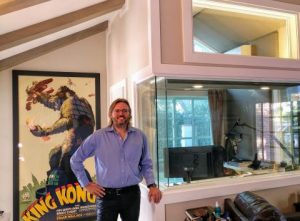
A sunny, custom built glass enclosed voice over booth with breathtaking outdoor views. A state-of-the-art recording space where you peek over the mic and you are overlooking the sea. Working from a home voice over studio never looked so good. In fact, it is not accurate to call them “home” studios anymore. These are professional voice over studios for professional voice actors that happen to be in a home, and they sound as gorgeous as they look.
Like you, we at VOPlanet geek out over gear, especially when it is set up in such amazing spaces. So, we chatted with the expert: George “The Tech” Whittam. George is famous in the voice over community for (among other things) designing brilliant studios and audio chains for the top voice actors in the industry. He’s a good man to chat with about cool studios.
Howard Parker’s Studio 44 – Design by George Whittam
Let’s talk about Howard Parker and his studio. You designed an amazing recording space. Just breathtaking. What was Howard’s concept going into this project?
Howard wanted his “last studio,” his best creation yet. Knowing Howard, though, it’s likely not to be his last. He wanted to have lots of light, and not feel too much like he’s inside a box. He also wanted to be able to see the beautiful cut-glass window on the exterior wall, that was in existence beforehand. Beyond that, the rest was left up to me. I wanted to keep the ceiling in the studio as high as possible and follow the vaulted ceiling line.
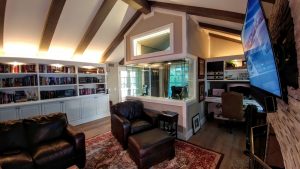
Howard Parker Studio 44 Designed by George The Tech Whittam. Image courtesy GeorgeTheTech.com.
What were the biggest challenges bringing Howard’s vision to life?
First, finding a builder willing to take on something totally new, but on a smaller scale than a whole home build, isn’t an easy task. Many of the great builders/contractors I’ve used over the years have become too busy on large/big budget projects to take on something like this. Engineering the shape of the room and a way to support such a large glass opening was a bit tough and require collaboration with the builder, George Beavers. While I have visions and ideas for designs, it’s often the builder who is left to solve the problems of exactly how to build something. I was also concerned about the acoustics of the space, how it would work out with so much glass.